Cancer Screening

Home > Cancer Screening

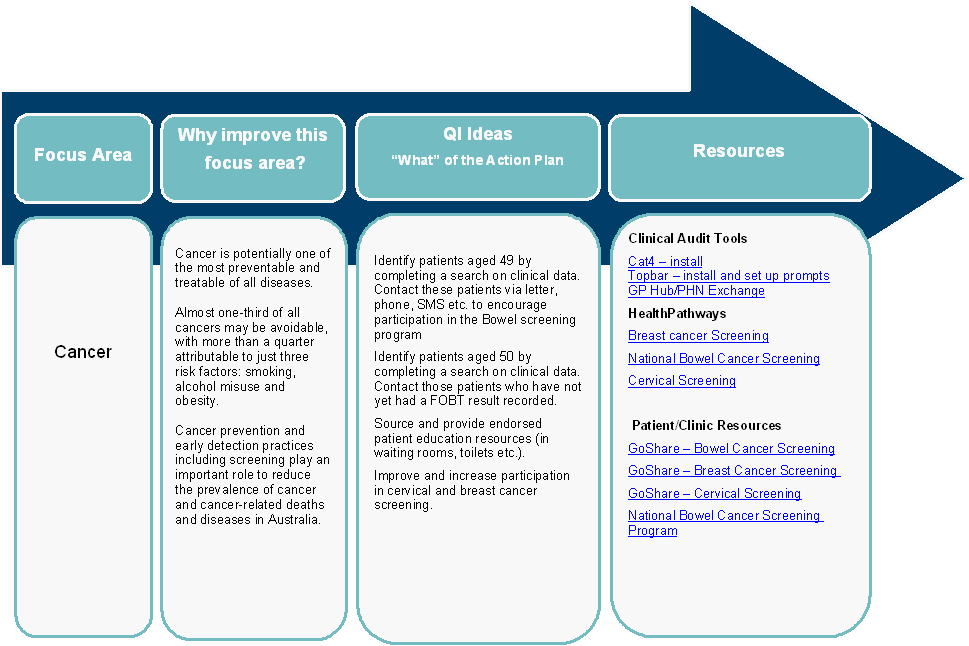
In Australia, there are three National Cancer Screening Programs for Cervical, Bowel and Lung Cancer. Each State offer Breast Screening Programs, for Victoria this is completed through Breastscreen Victoria. These National and State Cancer Screening Programs are public health interventions that can be initiated within a Primary Health Care or General Practice setting. Cancer screening is a proactive approach to detect cancer in its early stages prior to development of signs and symptoms. This approach provides more effective treatment options and better prognosis for patients.

If you have any questions relating to Cancer Screening, please contact our Primary Care Engagement Officers.

Email: qi@westvicphn.com.au

Phone: 1300 176 271

Programs Overview

The National Cervical Cancer Screening Program is targeted to women and people with a cervix aged 25 – 74 years old. Cervical Screening Tests (CST) are recommended every 5 years and can be collected by a certified practitioner in a clinic or self-collected. If more frequent screening is required, this will be guided by a medical practitioner.

CSTs test for the presence of the human papillomavirus (HPV) which cause almost all cervical cancers. There are different types of HPV, some are considered “low-risk” whilst others are considered “high-risk”. More information about HPV can be found on the Cancer Council website.

The HPV vaccine used in Australia is called Gardasil ®9. This vaccine protects people against nine types of HPV that are responsible for most HPV-related illnesses, including cervical cancer.

More information about the National Cervical Cancer Screening Program can be found on the Department of Health Disability and Aging website.

The National Bowel Cancer Screening Program is targeted to people aged 50 – 74 years old. People aged 45 – 49 years old can also request a free kit to be sent to them in the mail. A Bowel Cancer Screening Test is recommended every 2 years and is completed at home by the patient. A stool sample is collected testing for Faecal Occult Blood.

More information on FOBT results can be found on the Cancer Council website.

More information about the National Bowel Cancer Screening Program can be found on the Department of Health Disability and Aging website.

The National Lung Cancer Screening Program is the newest screening program in Australia. This program is targeted to people aged 50 – 70 years old who are asymptomatic (show no signs or symptoms suggesting lung cancer), currently smoke or have quit smoking in the past 10 years and have a history of tobacco cigarette smoking of at least 30 pack-years.

The Lung Cancer Screening test is completed via a low-dose computed tomography (low-dose CT) scan and requires a referral from a Medical Practitioner.

More information about the National Lung Cancer Screening Program can be found on the Department of health Disability and Aging website.

The Victorian Breast Cancer Screening Program is run through Breastscreen Victoria and is targeted to women, trans and gender diverse people aged 50 – 74 years old, without breast symptoms. A mammogram is a low-dose x-ray and is recommended every 2 years. 

More information about the Victorian Breast Cancer Screening Program can be found on the Department of Health Disability and Aging website.

Collaborate with WVPHN by telling us about your QI activity: